News
12,736 articles from 50+ sources
Europe Rejects Trump’s Demands for Warships to Reopen the Strait of Hormuz The New York Times
Leaders seek a diplomatic solution despite US president’s threat of ‘a very bad future’ for Nato unless it provides warships Middle East crisis – live updates European countries have ruled out sending warships to the strait of Hormuz, despite threats from Donald Trump that Nato faces “a very bad future” if members fail to help reopen the vital waterway. Germany ruled out participation in any military activity, including efforts to reopen the strait. “This is not our war, we have not started it,” said the country’s defence minister, Boris Pistorius. Continue reading...

Could Gulf states learn from Ukraine's drone revolution? Omar Ashour on Thu, 03/12/2026 - 23:15 As Iran targets US interests in regional countries, Kyiv's ongoing defensive efforts against Russia offer a blueprint for battlefield adaptation An interceptor drone used to protect against Russian drone attacks is pictured at an undisclosed location near the front lines of eastern Ukraine, on 9 October 2025 (Ed Jones/AFP) On In the first year of Russia’s full‑scale invasion, I argued that the under‑noticed defence inventories of the so‑called Global South still held Soviet‑legacy systems and calibres that could be repurposed for Ukraine’s immediate defence - less a grand strategy than a stopgap for force generation while western industry caught up. That argument rested on a simple fear harboured by every strategic planner: in an attritional fight, what matters is not only what you own on paper, but how quickly you can turn stocks into sorties, and procurement into sustained combat power. Four years later, the strategic irony is that the direction of traffic has flipped. Ukraine remains a recipient of western systems, but it has also become a producer of operational learning - an exporter of battle-space logic, procurement lessons, and counter‑drone methods. Europe’s long “holiday from history” is over; the Gulf’s current defence strategy against air and missile attacks suggests that it should internalise the same lesson, not theatrically but institutionally. Since the 1970s, the Gulf security architecture has relied heavily on US forward presence and missile defence, but the scale of recent attacks illustrates the limits of even advanced systems when confronted with mass mixed-vector raids. The lesson is therefore the expansion of partnerships, and the adaptation of defence architecture toward more scalable counter-drone layers. This is where Ukraine comes in - heavily. (adsbygoogle = window.adsbygoogle || []).push({}); Ukraine’s drone war is no longer a tactical novelty. It has become central to front-line operations, with relentless feedback loops between operators and industry. In 2025, the Ukrainian defence ministry planned to procure around 4.5 million domestically produced first-person view (FPV) drones, a figure that reads like industrial mobilisation rather than “innovation theatre”. Volume drives demand. According to Ukrainian President Volodymyr Zelensky, over the three-month winter period, Russia launched more than 14,670 guided aerial bombs, 738 missiles, and nearly 19,000 attack drones - an average comfortably above 200 attack drones per day. The point for Gulf planners is not that the Gulf must mirror Ukraine’s geography. It is that Ukrainian forces have been forced, nightly, to solve the hardest air‑defence problem there is: how to defeat mass mixed‑vector raids without bankrupting the defender. Composite threat That adaptation has been cyclical rather than linear. When electronic warfare made radio‑linked FPVs less reliable in Ukraine, tethered and fibre‑optic drones proliferated. When Ukrainians began recognising and acting on patterns, the Russians diversified their routes, increased attack volumes, and mixed in decoy drones. (adsbygoogle = window.adsbygoogle || []).push({}); Ukraine’s own officials have warned about the growing significance of fibre‑optic drones, precisely because they are difficult to jam. In parallel, soldiers in Ukraine are using improvised tools, such as nets or barriers, to help stop Russian attacks, reinforcing a lesson that Gulf and other militaries should heed: survivability is a combined product of expensive systems and cheap, scalable mitigation. Ukraine has become, under sustained aerial attack, the world's most battle‑tested school of countering terrorism from the air The threat shaping Gulf security is not a single missile or drone, but a composite strike architecture: ballistic missiles for speed and destructive effect, cruise missiles for low‑altitude penetration and precision strike, and one‑way attack drones and loitering munitions for saturation, decoying, coercion and cost imposition. The intent is operational and political: pressure on critical infrastructure - ports, airports, power, refineries and desalination nodes - while exhausting the defender’s interceptor inventory and decision cycles. Official tallies show the scale of Iran’s opening salvos. There have been 186 ballistic missiles and 812 drones detected towards the UAE; 101 ballistic missiles, 39 drones, and three cruise missiles detected towards Qatar; and hundreds more monitored or destroyed by Bahrain and Kuwait. From disclosed figures alone, the early total was already approaching 2,000 missile and drone threats - and that tally explicitly noted the absence of public data for Saudi Arabia and Oman at the time. As the first week of war progressed, official updates pushed the cumulative count higher. The wider Gulf picture thus cannot be treated as episodic. It is an air‑and‑missile defence campaign with all of Ukraine’s familiar burdens: readiness, resilience, stockpiles and replenishment. Question of sustainability This war’s most revealing datapoint is not merely how many targets were intercepted, but how many high‑end rounds were spent to do it - and what that implies for sustainability. According to Zelensky, Middle Eastern states expended more than 800 PAC-3 Patriot air-defence missiles within the first three days of the conflict - a significantly higher volume than Ukraine has used during the course of Russia’s war against it. Is that verifiable as a precise, audited figure? Not clearly. Neither Gulf defence ministries nor the Pentagon publish a public shot‑by‑shot expenditure ledger, and public threat tallies of inbound missiles and drones do not automatically translate into interceptor counts, as multiple interceptors may be fired for each incident. Zelensky’s tally should thus be read cautiously; more as an informed political warning than a number we can independently certify. But the strategic warning he makes is strongly corroborated: modern air defence can consume annual production rhythms in days. Andrius Kubilius, the European commissioner for defence and space, has highlighted the same problem. He said that roughly 700 Patriot interceptors were used during a four-month period in Ukraine, noting that Lockheed Martin produced only 600 PAC‑3 missiles in 2025. Add the fact that Iran has reportedly launched hundreds of missiles and more than 1,000 drones at Gulf states since 28 February, and you have the backbone of Zelensky’s argument, even if you treat the 800 figure as approximate. Battle tested Ukraine’s battlefield adaptation is not a moral story; it is a procurement and force‑design blueprint. That’s why there is a “race” to adopt Ukrainian counter‑Shahed techniques, tactics and procedures - and to embrace a “good enough” philosophy in operations, because exquisite high-tech systems alone cannot keep up with large-scale demand. That knowledge transfer is already starting. Qatari and western officials are exploring Ukrainian interceptor drones, detection methods and jamming approaches as cheaper complements to Patriot‑class interceptors. Why the Gulf fears Israel's 'day after' in Iran Read More » Meanwhile, Ukrainian manufacturers are positioning for export: a Reuters report cites one producer as saying that its P1‑SUN interceptor downed more than 2,500 enemy drones in four months, with claims of high monthly production capacity. The operational takeaway for Gulf defence planners is not to copy Ukraine mechanically, but to mimic its adaptation cycle and architectural logic. To defend against aerial threats, Gulf states should prioritise layered, scalable networks: distributed sensors, electronic warfare, mobile guns, low‑cost kinetic interceptors, hardened command and control, and passive protection for critical infrastructure, while preserving Patriot/Thaad/Aegis missile defence systems for the instances when they are really needed. The goal is to stay on the right side of the defence affordability frontier by maximising the value of defended assets per unit cost, and ensuring the attacker’s marginal cost of adding drones rises faster than the defender’s marginal cost of stopping them. Ukraine’s experience is therefore vital not only to Europe’s defence, but also to smaller states confronting larger aggressors - including many in the Gulf. And because Ukraine has become, under sustained aerial attack, the world’s most battle‑tested school of countering terrorism from the air, it is in the Gulf’s strategic interest that Ukraine does not fall to a colonial war of conquest in Europe. The views expressed in this article belong to the author and do not necessarily reflect the editorial policy of Middle East Eye. War on Iran Opinion Post Date Override 0 Update Date Mon, 05/04/2020 - 21:29 Update Date Override 0
'Not our war': U.S. allies balk at Trump's Strait of Hormuz demands NBC News
Pushback comes as US President Donald Trump says NATO allies should help secure key waterway amid soaring oil prices.
Qatar foreign ministry spokesman Majed al-Ansari accuses Iran of targeting civilian areas as he calls for de-escalation.
BERLIN/BRUSSELS/LONDON, March 16 (Reuters) - U.S. allies said they had no immediate plans to send ships to unblock the Strait of Hormuz, rebuffing a request by President Donald Trump for military support to keep the vital waterway open. Trump called on nations to help police the strait after Iran responded to U.S.-Israeli attacks by using drones, missiles and mines to effectively close the strategic channel off its shores for tankers transporting a fifth of global oil supply.
Qatar’s Foreign Ministry spokesperson Majed Al Ansari says Iranian attacks have targeted residential areas.
MADRID, March 16 (Reuters) - Spain will not take part in any military mission in the Strait of Hormuz because it considers the U.S.-Israeli war on Iran to be illegal, Madrid's defence and foreign affairs ministers said on Monday. The leftist coalition government led by Prime Minister Pedro Sanchez has criticised the offensive and banned participating U.S. aircraft from using jointly operated bases in southern Spain.
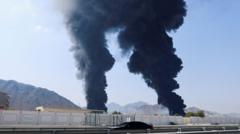
The port of Fujairah plays a crucial role in helping keep global supplies moving when the Strait of Hormuz is blocked.
Activists in South Korea have staged a protest against Donald Trump’s request for help securing the Strait of Hormuz.
3 Reasons China Will Ignore Donald Trump’s Demand to Contribute Forces to Re-Open Strait of Hormuz The China-Global South Project

Non-Iran tanker transits Hormuz with transponder on A non-Iranian oil tanker transited the Strait of Hormuz with its automatic transponder system activated, despite major disruption to shipping in the crucial waterway from the Middle East war, monitor Marine Traffic said Monday. "The Aframax tanker Karachi, carrying Abu Dhabi's Das crude, has become the first non-Iranian cargo to transit the chokepoint while broadcasting its AIS signal, suggesting that select shipments may be receiving negotiated safe passage," Marine Traffic said in a statement. This handout photo taken on 11 March, 2026 and released by the Royal Thai Navy shows smoke rising from the Thai bulk carrier 'Mayuree Naree' near the Strait of Hormuz after an attack. (AFP)
UK working with allies on 'viable' plan to reopen Hormuz Prime minister Keir Starmer said Monday Britain was working with allies to come up with a "viable" plan to reopen the Strait of Hormuz, the vital oil transport conduit effectively shut by Iran in the Middle East war. "We're working with all of our allies, including our European partners, to bring together a viable collective plan that can restore freedom of navigation in the region as quickly as possible and ease the economic impacts," Starmer told reporters, adding he had discussed the situation with US President Donald Trump. The UK leader added that while Britain was "taking the necessary action to defend ourselves and our allies, we will not be drawn into the wider war".
Recapping the Academy Awards and challenges reopening the Strait of Hormuz: Morning Rundown NBC News
Why Iran Is Allowing Bangladeshi Tankers Through the Strait of Hormuz MEPEI
Trump says Gulf countries should protect Strait of Hormuz US president Donald Trump said countries around the Strait of Hormuz should protect the waterway themselves. “Really, I'm demanding that these countries come in and protect their own territory, because it is their territory,” he said. “They should help us. You could make the case that maybe we shouldn't be there at all, because we don't need it. We have a lot of oil.” Trump on Strait of Hormuz: "Really, I'm demanding that these countries come in and protect their own territory, because it is their territory ... they should help us. You could make the case that maybe we shouldn't be there at all, because we don't need it. We have a lot of oil." pic.twitter.com/y97MflXvLs March 16, 2026
Trump Asks for Help With Strait of Hormuz, and Israeli Forces Kill Family in West Bank The New York Times
Iran said it was ready to take the Middle East war "as far as necessary" as it launched strikes across the region Monday, while Donald Trump piled pressure on world powers to help reopen a shipping lane choked off by the Islamic republic. Global oil prices have surged by 40 to 50 percent as Iran has attacked shipping in the Strait of Hormuz and launched waves of strikes in the Gulf, in retaliation for the war launched against it by the United States and Israel.
Iran’s Upper Hand in Hormuz Is Pressuring Oil Buyers and Trump Bloomberg.com