News
12,736 articles from 50+ sources

The conflict has split Trump’s MAGA following and prompted some Republicans to speak out

Half of UK news articles about Muslims are biased, landmark study finds Imran Mulla on Tue, 03/10/2026 - 12:14 Study of 40,000 articles from across 30 media outlets finds 'Muslims are systematically portrayed through lenses of conflict, threat, and controversy' A photograph taken on 16 June shows the website of British opinion-oriented television and radio news channel GB News (AFP) Off A new study of 40,000 articles from across 30 media outlets in Britain has found that almost half published about Muslims in the UK contained a "high degree of bias", and 70 percent associated Muslims or Islam with negative aspects or behaviours. The Centre for Media Monitoring (CfMM), a nonprofit organisation analysing the media's portrayal of Muslims, says in its report published on Monday that "Muslims are systematically portrayed through lenses of conflict, threat, and controversy" in the media. The report defines "bias" in terms of the "presence of negative associations with Islam or Muslims, use of broad generalisations rather than specific attribution, instances of misrepresentation, omission of contextual information or diverse perspectives, and quality of headlines". The report reveals that 70 percent of news articles in 2025 highlight negative aspects of Islam and Muslims, with 44 percent "omitting essential context". Seventeen percent of articles contain generalisations about Muslims and 13 percent feature "outright misrepresentation", the CfMM says, warning of a "crisis of public understanding". (adsbygoogle = window.adsbygoogle || []).push({}); It finds that nearly 50 percent of all pieces published about Muslims in the UK "contained varying degrees of bias". The CfMM accuses a "cluster of right-wing publications" of producing most of the biased coverage. The Spectator had the highest proportion of "very biased" coverage (26 percent), followed by GB News (15.6 percent) and The Telegraph (12.3 percent). 'Systematic pattern of hostile coverage' The CfMM accuses GB News of having "embedded a systematic pattern of hostile coverage towards Islam and Muslims as a core feature of its editorial identity." Meanwhile, it says the BBC "consistently records the lowest or near-lowest rates of bias among major outlets across all metrics". (adsbygoogle = window.adsbygoogle || []).push({}); Significantly, the report finds: "Generalisation about Muslims is almost exclusively a right-wing editorial practice." UK government unveils new definition of anti-Muslim hatred Read More » It says that this proves "harmful coverage of Islam and Muslims cannot be attributed to media-wide tendencies alone", and that "the level of harmful coverage a publication produces is a product of deliberate editorial decisions rather than the inevitable constraints of news reporting". One GB News piece highlighted in the report was headlined "Let me be impolite: Muslims are racist against Jews". The CfMM report says the article itself attributes "antisemitism and violence to Muslims as a whole and to Islam as a religion", with "individual acts of violence" framed as products of "the ideology of Islam". Another article, in The Sun newspaper, was entitled: "'KILLER' FAMILY Gagged and tied teen thrown into swamp & left to drown 'by her BROTHERS' in Muslim sick 'honour killing over Western behaviour'". The CfMM said it complained to The Sun, arguing the headline linked the honour killing to Islam without evidence - after which The Sun amended its headline to remove the reference to Muslims. Rizwana Hamid, director of CfMM, said: "As the largest study of its kind ever conducted in the UK, this report presents deeply concerning evidence of structural bias in how Muslims are portrayed in the UK press." Hamid added that it "points to a systemic problem within our media ecosystem. When entire communities are repeatedly framed through lenses of suspicion or threat, it inevitably shapes public attitudes, political debate and the everyday lives of British Muslims". Research by the think tank Equi found a 43 percent rise in anti-Muslim incidents between 2023 and 2024, but revealed that public attitudes towards British Muslims are far more positive than political and media discourse often suggests. 'This report presents deeply concerning evidence of structural bias in how Muslims are portrayed in the UK press' - Rizwana Hamid, director of CfMM Equi also found that a majority of the public holds either favourable or neutral views of Muslims, and this increases when people are shown real examples of Muslim contributions to British society, from charity work to community engagement. The CfMM report was released on the day that the government unveiled a new non-statutory definition of anti-Muslim hostility after months of consultation and controversy surrounding the process. Communities Secretary Steve Reed said in the House of Commons: "Religious hate crimes targeted at Muslims are also at record levels, with almost half of these crimes targeted towards the Muslim community and many living in fear that they will be targeted because of how they look or assumptions over where they come from." The definition describes anti-Muslim hostility as criminal acts directed at Muslims "because of their religion" or at "those who are perceived to be Muslim", as well as "prejudicial stereotyping" and "engaging in unlawful discrimination" intended to "disadvantage Muslims in public and economic life". UK Politics News Post Date Override 0 Update Date Mon, 05/04/2020 - 21:19 Update Date Override 0

submitted by /u/No-Post4444 to r/worldnews [link] [comments]
BERLIN, March 10 (Reuters) - German Chancellor Friedrich Merz underlined growing concern in Europe at the U.S. and Israeli war against Iran on Tuesday saying a "dangerous escalation" was underway with "clearly no joint plan" for bringing it to an end. Merz's comments, which echoed remarks he made at the end of last week, came after U.S. President Donald Trump said the war could end "soon" but also said the U.S. could escalate its attacks if Iran sought to block tanker traffic through the Strait of Hormuz.
Strikes create toxic clouds over Tehran Reuters
In Israel’s missile war, some families run to shelters. Others have nowhere to go. Jewish Telegraphic Agency
Journalists covering the war in the Middle East are facing increasing restrictions and censorship imposed by governments and armed groups, with reporters being stopped and questioned or even detained, a survey of AFP bureau chiefs from the region showed. Some of the tightest restrictions are in Iran and Israel, although Gulf monarchies, targets of unprecedented drone and missile attacks from Iran, have also imposed tighter controls.
Five ways the Iran war could unfold Financial Times
Ukraine has battle experience with Iranian-made Shahed drones and has mass-produced cheap interceptors.
Hegseth says US will end war with Iran ‘on our timeline’ CNN
Iran uses warheads weighing over one tonne against Israeli-US targets, IRGC say Iran's Islamic Revolutionary Guard Corps (IRGC) announce the 34th wave of attacks against US-Israeli targets "with pinpoint missiles and warheads weighing more than one tonne". According to the Iranian Tasnim agency, the commander of the IRGC Aerospace Force announced yesterday that they will use missiles with warheads weighing one tonne or more.
As the US and Israel's war on Iran widens Europe is caught in a bind. It wants to help partners in the Gulf but worries key equipment needed in Ukraine may be diverted by the US to the Middle East. #dwnews facebook.com
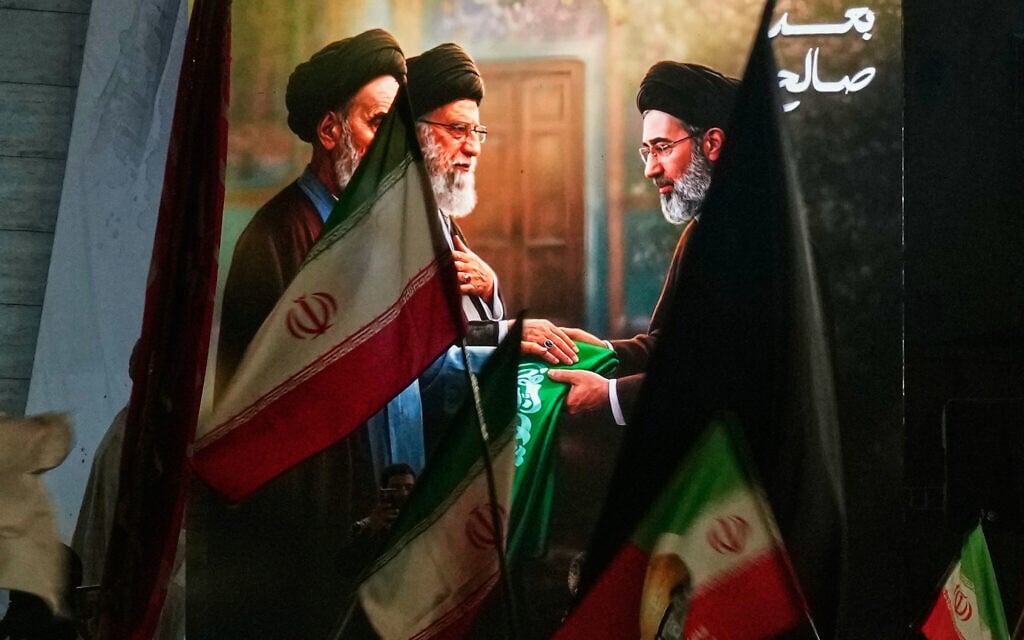
Washington and Jerusalem hope the bombing and protests will destabilize Tehran. But experts believe that even weakened, the regime could take a long time to collapse while still remaining a global threat The post A long road to the end: The death throes of Iran’s regime could last for years appeared first on The Times of Israel.
Farage U-Turns to Say UK Shouldn’t Get Involved in Iran War Bloomberg.com

'Boogeyman mullahs': How decades of anti-Iran hysteria set us on the path to war Nura Hossainzadeh on Tue, 03/03/2026 - 08:18 Western portrayals of the Islamic Republic as irrational and one-dimensional, devoid of political complexity, have helped ingrain prejudice and normalise a once-unthinkable war A man sits beside portraits of Ayatollah Ruhollah Khomeini and Ayatollah Ali Khamenei during a burial ceremony for a person killed in recent US-Israeli strikes, in Tehran on 9 March 2026 (Atta Kenare/AFP) Off The unthinkable has happened: the United States and Israel have launched a war on Iran, now in its second week. More than 1,300 people have reportedly been killed by American taxpayer-funded munitions, and some 100,000 displaced, while hospitals, schools, playgrounds and other civilian infrastructure have been destroyed. The assassination of Iran's supreme leader, Ayatollah Ali Khamenei, in the opening US-Israeli strikes on 28 February was intended to decapitate the country's leadership and advance the regime-change goals openly declared by the Trump administration. Instead, large crowds have gathered in squares across Iran to mourn Khamenei and denounce the attack, even as the country continues to come under bombardment. Over the weekend, his son, Mojtaba Khamenei, was named the country's new supreme leader in what officials described as a show of "dignity and strength", despite threats from Israel and the US that any successor would become a target. For many observers, this is simply the latest example of an unhinged Donald Trump leading the US down a dangerous and self-destructive path. (adsbygoogle = window.adsbygoogle || []).push({}); But the story goes beyond Trump. The road to this war was paved long ago by people who refused to see Iranian politics as anything more than one-dimensional. This flat and uncomplicated picture has persisted in the public imagination for decades. The war feels especially tragic to me because I spent years doing work that I hoped might prevent it. I contended that in Khomeini's vast corpus of writings and statements he was often, put simply, a democrat As a political science graduate student at UC Berkeley, I wrote my dissertation on Ruhollah Khomeini, leader of Iran's 1979 revolution. As a political theorist, I hoped to encourage greater understanding of, and critical engagement with, the political theory of the Islamic Republic's founding father and the political system he shaped. The experience taught me just how deeply ingrained prejudices about Iran are in western discourse, even among many left-leaning academics who pride themselves on open discussion of controversial ideas. My argument was certainly not one they were used to hearing. I contended that in Khomeini's vast corpus of writings and statements he was often, put simply, a democrat. His opposition to the two 20th-century Pahlavi monarchs was based in part on the way they gained political power - by force, through a coup. Rethinking Khomeini In 1979, Khomeini insisted that the legitimacy of Islamic government rested upon the popular referendum in which people voted in favour of creating an Islamic republic. Khomeini made an argument, in other words, for government by the consent of the governed. Indeed, Khomeini envisioned a strong role for Islamic legal scholars in government, ensuring that national law did not violate the shari'a. But he also said that even the most powerful legal scholar in government - the "supreme leader", as it is often rendered in the western press - must be criticised and assessed by ordinary people. Israel planned this war on Iran for 40 years. Everything else is a smoke screen Read More » On 7 November 1979, for example, he said in a speech that the leader "is a person whose ethics, religiousness, devotion to the nation, knowledge, and action, in all of their dimensions, have been established [as commendable] in the view of the people". This principle was incorporated into Iran's constitution. The Assembly of Experts, a popularly elected body with the power to oversee and dismiss the leader, remains in place to this day - although reformists argue it has not exercised this authority forcefully enough. Though Khomeini sought to empower legal scholars, he also described Islamic law as "progressive and evolving" and parliament as the "highest station" in government, responsible for applying Islamic law to contemporary issues. On several occasions after the revolution, he said publicly that elected representatives have a better sense of the country's needs than clerics and can pass necessary laws, even if doing so suspends certain provisions of shari'a law. Often, in his writings, it was unclear who - parliament or legal scholars - had the final word when it came to matters of the law. He spent the rest of his life working out the respective powers of legal scholars and representatives. But for many audiences, even suggesting that Khomeini's thought was more complex than commonly portrayed, and open to different interpretations, provoked hostility. Some listeners seemed unable to see him as anything more than a caricature. I recall the angry questions, raised voices, flushed faces and hysterical denials of Khomeini's human complexity and contradictions, as well as accusations that I must surely have a political agenda. Their reaction was, in many ways, unsurprising. The English-language literature on Khomeini's thought was itself rife with distortions. One prominent author claimed that Khomeini believed clerics should rule "on behalf of God", while another described his ideas as part of an agenda for "restructuring consciousness". Such portrayals were reinforced by media coverage and in popular culture. (adsbygoogle = window.adsbygoogle || []).push({}); By accepting this depiction of Khomeini, many academics also misread Iranian politics. They failed to see that reform in Iran might emerge within the broad framework of Islamic republicanism, and that change did not require overturning the political system. In fact, one needed to look no further than the Islamic Republic's own founding father to find arguments for reform. Internalised caricatures The same misrepresentations of Iran are resurfacing in this crucial moment. Even liberals who oppose American and Israeli military aggression can scarcely say a word in opposition to the war without first reminding us that Iranians are also suffering at the hands of their own government. In doing so, they reveal how far caricatures of Iran have been internalised. The result is a discourse that ultimately reinforces the very imperial aggression they claim to want to contain. (adsbygoogle = window.adsbygoogle || []).push({}); This is not to say that the Islamic Republic - like any state - should not be subject to criticism, that protesters do not have the right to take to the streets, or that the state has not violated legitimate freedoms. But simplified claims that the Iranian people are merely muzzled and oppressed gloss over the ongoing struggles within Iran for political reform. They also erase reformist voices seeking to strengthen the Islamic Republic's democratic credentials - figures such as Ahmad Zeidabadi and Mostafa Tajzadeh - who continue to speak, even if they have faced imprisonment. Reformists are weakened and persecuted, but they have not disappeared. Reducing Iranian politics to a struggle between tyranny and resistance forecloses the possibility that Iranians may resolve their political struggles internally. It also plays directly into the hands of warmongers who claim military intervention is the only solution. Liberals who denounce both the Islamic Republic and imperial aggression in the same breath have helped construct precisely the image of the "boogeyman mullahs" that now underpins the war on Iran. It is no wonder that the Islamic Republic, born out of resistance to American hegemony and to a shah installed by a CIA-backed coup, has long been vilified in the centres of power it opposes. Ayatollah Khamenei maintained his predecessor's anti-imperialist stance until he was killed by the same "bully" powers he had openly condemned for decades. As he said in a speech last October: "Why has the US established all these military bases in various countries throughout West Asia? What are you doing here? What does this region have to do with you?" Opponents of imperialism would do well to remember this defining feature of the Islamic Republic's politics and recognise the connection between the war now being waged on Iran and the country's refusal for nearly half a century to capitulate to hegemonic power. Instead, Iran is once again depicted as nothing more than a force for evil in the world. Preparing the ground The characteristic flattening of Iran's politics was evident in media coverage of the January unrest, when Iranian protesters were killed in large numbers. Even left-leaning outlets often depicted the events in simplistic terms, helping to condition public opinion for confrontation with the Islamic Republic. Another factor largely ignored in western coverage was the intentional role of American sanctions in fuelling economic anger What received far less attention was evidence suggesting the involvement of foreign actors in the unrest. Israeli media reported that on 29 December 2025, the Mossad Farsi account on X posted that its agents were "literally physically" present with protesters on the ground. Right-wing Israeli television presenter Tamir Morag further proclaimed that Israeli intelligence played a role in the violence, which Israel has yet to deny. On X, former US Secretary of State Mike Pompeo brazenly posted: "Happy New Year to every Iranian in the streets. Also to every Mossad agent walking beside them." That Israeli and American intelligence agencies were sowing chaos with the aim of spilling blood and blaming the Iranian government was hardly secret. Iranian security forces certainly bear responsibility for the violence, but the situation was far more complex than had been portrayed. Mainstream news outlets either ignored reports of foreign agents being involved or referred to them only briefly and without serious investigation. Many also repeated an uncorroborated statistic claiming that 30,000 people had been killed, even though those reporting the figure offered no evidence to support it. Meanwhile, estimates cited by groups such as the US-based Human Rights Activists News Agency (HRANA), place the toll far lower, at around 6,000, while the Iranian government puts the death toll closer to 3,000. The president's office even launched a website inviting citizens to report additional casualties. The failure to investigate foreign-instigated violence, combined with the uncritical repetition of unverified death tolls, helped reinforce a simplistic "boogeyman" narrative, preparing hearts and minds for war. An image grab from Iranian state television shows the site of US-Israeli strikes that hit the Shajareh Tayyebeh girls' elementary school in Minab, in Iran's southern Hormozgan province, on 28 February 2026 (IRIB TV/AFP) Another factor largely ignored in western coverage was the intentional role of American sanctions in fuelling economic anger. US Treasury Secretary Scott Bessent stated openly that Washington had "engineered a dollar shortage" in order to push Iranians into the streets. Protesters undoubtedly had legitimate grievances about corruption and political freedoms, but many were also reacting to the government's inability to alleviate economic hardship caused by sanctions. Yet coverage of the protests in The New York Times and The Guardian, like that of many other outlets, did not include a single mention of US sanctions. To quote Bob Dylan, "And the newspapers, they all went along for the ride." Journalists who should have the integrity and professionalism to examine issues in all their complexity were unwilling to do so when it came to Iran, just as my academic audiences could not stomach it when discussing Khomeini and the Islamic Republic. Subduing the 'monster' When a country is portrayed as an irrational, raging monster of a regime, what do you do with it? You subdue it. Americans who have been fed this distorted story for decades are unlikely to object. There was no nuclear threat. US-Israeli war on Iran is blind vengeance Read More » Ordinary people are already paying the price for Washington's refusal to pursue dialogue and diplomacy. As usual, American and Israeli bombs care little for civilian life. War Secretary Pete Hegseth even boasted that US forces were delivering "death and destruction from the sky all day long", romanticising the sadistic violence that claims innocent lives. That death and destruction includes 168 girls and boys killed when a strike hit the Shajareh Tayyebeh girls' elementary school in Minab on 28 February - an attack Unicef condemned as a "stark reminder of the brutality of war and violence on children". What is the lesson here? The road to this moment was paved by our own prejudices. When the politics of other countries are reduced to simple narratives, it becomes easier to make the case for war and wage it without meaningful opposition. For decades, Iran has been depicted in popular discourse and academia as a regime of "mullahs" - a term often spoken with Islamophobic disdain. Even the most educated among us struggle to see it any other way. How can it come as a surprise that we are now at war with Iran? Do Americans know that Iran's constitution allows the Assembly of Experts to dismiss the supreme leader? Or do we prefer to drop bombs instead? We often hear that reform candidates are prevented from running for office. But do western audiences know that Iran's constitution does not explicitly grant any institution the authority to vet candidates based solely on their political leanings? When key aspects of Iran's political system - its constitution, reform discourse inside the country and Khomeini's own theory of Islamic government - remain unfamiliar to western audiences, why should it surprise us that we dismiss the possibility of reform and instead seek, in what will almost certainly be a futile effort, to resolve political problems with bombs? Shamefully, in our violent and arrogant attempt to impose political reform in Iran, we stand in the way of homegrown change Shamefully, in our violent and arrogant attempt to impose political reform in Iran, we stand in the way of homegrown change. I say this as an American who wrote about Khomeini in the belief that showing his theory is not one-dimensional might open space for dialogue, including with conservative Iranians whose voices are rarely heard in the media and who still believe in his ideas. I hoped it could help prevent the horrors we are witnessing today. At this point, all that can be done is to resist the narrative the warmongers will continue to repeat: that America and Israel are doing what needs to be done to rid the earth of an evil regime, and that Iranian and American blood must be shed for this cause. But the truth is rarely so simple. We must oppose this war and advocate for a path forward that recognises the sovereignty of the Iranian nation and the right of its people to determine their own political future. We must sharpen our minds and see through opportunistic portrayals of political systems beyond our borders. Our ability to live at peace - now and in the future - depends on it. The views expressed in this article belong to the author and do not necessarily reflect the editorial policy of Middle East Eye. War on Iran Opinion Post Date Override 0 Update Date Mon, 05/04/2020 - 21:29 Update Date Override 0

Yes, many Americans are struggling, but it’s good to know the first family can still afford Earth’s most expensive provisions. Morale is everything, isn’t it? In the absence of any clearly and consistently stated aims from the US administration, maybe each day of the Iran war just needs a moodboard description. In which case, Sunday was a tale of two nepo babies. In Iran, the high-level executive search for the new ayatollah concluded that the old ayatollah’s son was the best man for the position. It’s not for me to assess his job prospects, but you’d hope his supermarket order doesn’t contain any “ripen at home” pears. Meanwhile, across the world, in LA, Donald Trump’s eldest granddaughter posted a YouTube video titled “I Brought My Secret Service to Erewhon”. By way of background, Erewhon is Earth’s most pretentiously extravagant hipster food shop, and, as Kai was at pains to brag, “the most expensive grocery store pretty much out there. Everything’s crazy expensive! So we’re going to get my favourite stuff.” Marina Hyde is a Guardian columnist Continue reading...

TEHRAN, Mar. 10 (MNA) – Secretary of Iran’s Supreme National Security Council Ali Larijani cautioned US President Donald Trump about his potential elimination, stressing that the resilient Iranian nation is unafraid of hollow threats.
Iranian barrages target Israel and Gulf countries as Hegseth warns Iran of 'most intense day of strikes' PBS

submitted by /u/PestoBolloElemento to r/worldnews [link] [comments]
APTOPIX Iran US Military Deaths Casualty Return Rutland Herald