News
12,736 articles from 50+ sources
What to know about the Strait of Hormuz, a key passageway essential for global energy supply WISN
Live - Iran mines Hormuz as Trump says few targets left ایران اینترنشنال
Qatar announced a production halt at a facility last week and declared force majeure on LNG shipments.

submitted by /u/BezugssystemCH1903 to r/worldnews [link] [comments]

submitted by /u/walter-gianno to r/geopolitics [link] [comments]
Trump has ‘no answers’ on Strait of Hormuz: Jake Sullivan The Hill
Iraq shoots down drones near Baghdad airport Four drones were shot down near Baghdad International Airport, Iraq’s state news agency reported. A US State Department official said a drone struck a US Embassy operations centre at the airport overnight. The official, speaking on condition of anonymity as the investigation continues, said the Baghdad Diplomatic Support Center was targeted by Iran-backed military groups based in Iraq. Washington condemned the attack and said it was in contact with Iraqi authorities about steps to protect US personnel and facilities amid the US-Israeli war on Iran and its wider spillover in the region.
Attacks have targeted around 20 commercial vessels in or near the Strait of Hormuz, data analyst groups report, as the blockaded waterway becomes a front line in the Middle East war. Iran's quest to inflict maximum pain on the global economy in retaliation for US-Israeli strikes on its territory has all but shut the narrow strait through which 20 percent of global crude and LNG normally passes. Only a tiny fraction of the vessels that used to navigate the strategic waterway have made it through, while some have ended up in flames. - Vessels hit -

People on the coast of the United Arab Emirates can see oil tankers and cargo ships line up in the Strait of Hormuz while playing on swings, riding horses and camping out on the beach near Khor Fakkan, as the war in Iran affects the global energy supply.

submitted by /u/Christian-Rep-Perisa to r/worldnews [link] [comments]

'If I don't work, I go hungry': The migrant workers risking their lives to keep the Gulf running Areeb Ullah on Wed, 03/11/2026 - 13:54 Migrant workers from across the Gulf share the experience of having no choice but to work despite the threat posed by Iranian missile strikes Migrant workers sit on a wall against the backdrop of the city skyline as they take a break in Dubai on March 11, 2026 (AFP) Off The day after the missiles struck the Gulf, a Bangladeshi delivery rider in Dubai was back on his bike. The roads were quieter than usual, but the tips were better. But for a Pakistani rider who has spent four years working 12-hour shifts in the same city, there was never really a choice. “I came here to earn money, and working in any situation has become a necessity for me,” the driver told Middle East Eye. “Although many people feel afraid, we riders still have to continue working with courage. I get paid for every delivery. So if I do not work, I may go hungry.” The worker is one of hundreds of thousands of cleaners, construction workers, drivers and security guards keeping the Gulf running as the region comes under attack by Iranian missiles. (adsbygoogle = window.adsbygoogle || []).push({}); Since the conflict between Iran, the US and Israel escalated, Iranian strikes have killed at least 12 civilians across the Gulf states. Notably, in the UAE, every civilian casualty so far has been a migrant worker from Bangladesh, Nepal or Pakistan. Among the dead was Saleh Ahmed, 55, from Bangladesh, who was killed while delivering water in the UAE on the first day of the war. But as missiles target the Gulf, the region’s vast population of migrant workers - who make up the majority of residents in countries such as Qatar and the UAE - are being left to fend for themselves, according to a human rights organisation with researchers embedded in the affected countries. Mustafa Qadri, executive director of Equidem, told MEE that the organisation’s network of migrant worker investigators across the UAE, Qatar, Saudi Arabia and Jordan has documented widespread panic, psychological trauma and systematic exclusion from official safety measures. “There is universal trauma, panic, worry, regardless of who the workers are,” said Qadri. Huge crude oil spike and Asia plummet: How the Iran war hit the markets Read More » “And I’m talking about workers that come from different countries, different jobs - both men and women.” Qadri said workers face two distinct forms of discrimination. The first is exclusion from official safety communications. While some formal statements have referenced all residents, workers on the ground say they have not received meaningful guidance on shelters, evacuation routes or emergency support. The second is structural discrimination. As essential workers in every sector of Gulf society - construction, hospitality, healthcare, security, domestic service and logistics - many of these workers are required to continue working through attacks, often moving toward danger rather than away from it. "There is a conscious choice made to get workers that are from relatively poor countries, who don't get paid as much and have a lot less power in the social dynamic of these countries, to do this difficult work - because they're less likely to complain or to demand protection," Qadri said. Particularly alarming, he added, is the situation of delivery riders and other gig economy workers, who remain on the streets while their wealthier clients shelter at home. (adsbygoogle = window.adsbygoogle || []).push({}); And since the start of the conflict, more and more residents in the Gulf are using delivery services, opting to stay inside instead of venturing out to buy basic goods and necessities. ‘Back to back orders’ MEE spoke to three delivery riders working for major platforms in the UAE, all of whom described continuing to work through the attacks with no instruction, support or choice. The drivers described an increased workload since the onset of the war and wished to remain anonymous to protect their employment. 'Although many people feel afraid, we riders still have to continue working with courage.... If I do not work, I may go hungry' - Pakistani delivery driver in Dubai A Bangladeshi rider who has worked for his company for two years said that on the day of the first attack, the roads were empty. But the day after, he was back out making deliveries. Customers, he noted, were tipping more generously than usual. A Pakistani rider based in Abu Dhabi, who has been in the country for five years, described the days immediately following the attack as relentless. With many local residents refusing to leave their homes, orders kept flooding in. “I worked day and night, taking only short rests,” he told MEE. He believed only around 70 percent of the usual number of people were out on the roads. People, he suspected, were bulk-ordering food and groceries in anticipation of the situation worsening. Another Pakistani rider in Dubai, who has worked for the same company for four years, described a system that offers no margin for fear. He lives in a shared rented room with friends, works 12-hour commission-based shifts, and said stopping was not an option. “The company only pays me for the orders I complete,” he said. “If I do not work, I do not earn anything.” As the attacks unfold, migrant workers are also becoming the primary witnesses documenting their impact. Much of the visual documentation of strike impacts circulating online has been captured and shared by migrant workers filming on their phones. The war on Iran has ignited rare civil unrest in Bahrain Read More » Earlier this week, Bahrain arrested five Pakistanis and one Bangladeshi worker for allegedly praising Iranian strikes while filming footage of the aftermath of the attacks. Qadri fears more workers could face arrest and bear the brunt of any further crackdown, particularly in the UAE, which has a strong track record of imprisoning people who film security-related incidents. "It's very similar to Gaza, where the most vulnerable people in a society become the eyes and ears in a conflict zone," Qadri said. "They should not face persecution for doing that." Compounding the crisis is the historically poor record of sending countries - among them Nepal, Kenya, India, Bangladesh and Ethiopia - in providing meaningful consular support to their nationals. While communities back home are pressing their governments to act, Qadri said the response so far has been inadequate. Workers on US and western military bases in the Gulf, many of them Nepali nationals hired specifically because of Nepal’s perceived neutrality, are thought to be particularly exposed. Standard operating procedures on such bases typically evacuate western civilians when risk rises - while essential services continue to be run by migrant workers who remain behind. (adsbygoogle = window.adsbygoogle || []).push({}); "The US, which started this war, and other western nations, which are mostly indirectly supporting it - they've got a lot of political pressure to get their own nationals out of the region. So there's not much pressure from those states to make sure migrant workers are protected," Qadri said. Numbness In Qatar, Shaheen Abdullah was turning onto the main road near his house when the explosions began. He stopped the car. A piece of shrapnel, still on fire, fell directly in front of him. His family, in the car behind, saw everything. “I wish they hadn’t seen it,” he told Middle East Eye. He called the police. While they put him on hold, officers arrived and cordoned off the area. “I was stunned by the moment, but then I didn’t give it much thought.” Iran war and Hormuz shock fuels cost-of-living crisis across South Asia Read More » That numbness, he says, has become the norm. Abdullah runs a shop in Doha and describes a community of migrant workers who have no option but to absorb what is happening and carry on - the shops, restaurants and delivery services cannot close. “Nobody can take a day off,” he said. He also points to a sharp disparity in how different communities are responding. “Everyone is watching how European countries are evacuating their citizens,” he said. “But evacuations are not in the minds of people who have nothing to go back to. They can’t afford any of that.” When the conflict does come up in conversation within his community, Abdullah says the discussion rarely turns to personal safety. “The conversations are not about wellbeing or safety. They’re political and existential.” Trauma, he says, goes unspoken. “Mental health is passive. It’s about being prepared and navigating this if it prolongs. Spending 15 minutes of our day worrying about falling shrapnel is something people have made peace with.” War on Iran News Post Date Override 0 Update Date Mon, 05/04/2020 - 21:19 Update Date Override 0

Strike that killed at least 175 people, most of them children, reportedly due to targeting mistake by US military planners Minab school bombing: a visual guide A preliminary US military investigation has reportedly determined that Washington was responsible for a deadly Tomahawk missile strike on an Iranian elementary school in February that killed scores of children. According to the New York Times, quoting unnamed US officials and others familiar with the initial findings, the investigation has concluded that the strike on 28 February on the Shajarah Tayyebeh elementary school building was the result of a targeting mistake by the US military planners. Continue reading...

British prime minister received document in 2024, before appointing Peter Mandelson as Washington ambassador, in which officials worried about his ties to convicted sex offender The post Files show UK’s Starmer was warned of ‘reputational risk’ to Epstein-linked US envoy appeared first on The Times of Israel.
U.S. Plan to Unblock Strait of Hormuz Collides With Realities of Global Insurance WSJ

Iran is not in a position to participate in the 2026 World Cup, says the country's Minister of Sports and Youth.
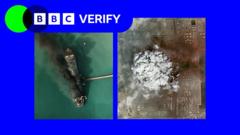
BBC Verify examines the impact of new image restrictions from major satellite provider Planet Labs.
President Trump warns Iran against attacks in Strait of Hormuz CBS News
Pace of Iran’s Retaliatory Strikes Appears to Be Slowing The New York Times
Hormuz: Iran is escalating the war by attacking ships along a key oil route. Here’s what we know. CNN
Iran is escalating the war by mining a key oil route. Here are the risks CNN